Today you're going to make a poster explaining the features of your animal. We're in the library so you can use the colour printer to create an eye catching poster to tell people about the adaptations your animal has. You need to work as a group to produce a poster showing:
The name of the animal (species name, not what it's friends call it!).
Where it lives.
What it eats.
What colour it is (and WHY).
Any other adaptations it has.
Why it is important to the ecosystem.
Cut out your sections from powerpoint slides and stick them on your poster. We will finish painting the animals next week and make a display in class with them.
Today you're going to continue planning your animals from last lesson, thinking about the structures that help them survive. Answer the following in your books, and remember you will need these next week!
What colour is your animal? How does this help it?
Today we're going to finish off revising for the test tomorrow in class. make sure you have your handouts from last week, and complete the following in your books:
Explain how you would make an electromagnet. How is this different from a normal magnet?
How can magnets be made to repel each other? How can they attract each other?
Extension - Do some reading and find out how maglev trains work. Why are they better than normal trains?
This video helps you look at examples similar to those we saw in class.
Finally, try this activity. Which charges attract and repel each other?
HOMEWORK - Read through these questions and your notes from last week, to mae sure you're ready for the test in period 2 tomorrow! Come and ask Mr. Cole beforehand if you have any questions.
Today we will be working in groups of two on presentations for tomorrow. They will go for no more than 2 minutes each and will deal with one question about this topic. Some will be about heating, and some will be about magnetism. The tasks for today are:
Organise a group of two and get a question from Mr. Cole.
Find information on the internet or in your books about your topic, and make sure you understand it!
Make 2-5 powerpoint slides about your topic, and write a script so you will know what to say.
Practice your part so you know what to do, there will be prizes for good presentations!!
We will present these tomorrow in J18, so make sure you come on time. For homework, read over your section so you know what you will say in front of the class.
Watch this video. Explain how Heston uses conduction, convection and radiation to create the meal:
Think of your favourite hot food. Find a picture of it, and put it on a powerpoint slide. You need to use arrows and axplanations to show HOW the food is heated (by conduction, convection, radiation, or more than one) and where the heat comes from. Save this and we will print it if we can.
Homework:
For one meal you have this week, explain what you had which was cooked and how it was heated. Make sure you use thte terms from class today. Bring it in next week. on Monday.
Today we're going to be working on the topics that we will continue with after half term - heating, cooling and magnetism. Answer the following in your books.
Watch this animation. What are the three ways that heat can be transferred?
Try this quiz (it's pretty hard so don't worry if you get some wrong!).
Last of all, try and find out what coccolithophores are and what part or Britain they helped create. There's an achievement point for anyone wo can do this!
Today we're going to start revision for the test which we will sit on Friday. It will cover what we've done since half term - microbes and ecosystems. Complete the following in your book.
Today we're going to keep looking at how factors in the environment influence which animals and plants can live there. We are also going to start talking about food chains. Complete the following in your books:
What environmental factors does a crocodile need to survive?
Do plants all need the same soil pH or different ones? Give an example of the preferred soil pH for one plant type:
Try this game (you'll get an achievement point if you complete all the questions and finish this!). What is the name for all the food chains in an ecosystem?
Today we're going to do some summary work on light and how our eyes work. Answer the following questions in your books, working in pairs with the computers:
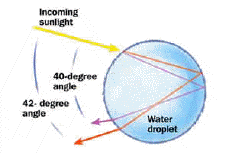
The picture below is a diagram of a raindrop creating a rainbow. What is the term for when the light bends as it enters or leaves the drop? What about when it bounces off the back?
3. Why do rainbows from as semi-circles? Where would you need to be to see a complete circle rainbow?
4. What else does the cornea do apart from protecting the eye?
5. Complete the first four 'quick quiz' questions about light being reflected and absorbed. What happens for us to see an object as blue?
6. Watch this video. Do sound or light waves travel quicker? How fast do they each travel?
7. Extension - Provide a summary of the Doppler effect using the words wavelength, frequency and moving.
Finally, we're going to make some bunting to go on the room of w12. Take a coloured triangle and write/draw 1 interesting fact you know from this unit about sound and light. Then come to the front and stick it on the string!
Wednesday, 16 January 2013
Today we will be looking at sound and hearing. Answer the following in your books:
Today we're going to finish looking at the human body/respiration section of the course and prepare for the sound and light unit we're going to do next term.
Complete the following:
Make sure you've seen your test paper, and written a sentence in your book about it. 'I achieved%. To improve, I am going to keepand start .'
What was one part of this term that you enjoyed?
What was one thing about science this term that you would like to change?
Complete this activity. What do our red blood cells do for us?
Today we're going to finish up looking at respiration, ready for some practicals and revision for the unit test coming up next week. Answer the following in yoru books:
Write down the full equation for cellular respiration. You will NEED to know this off by heart!
What cells in the blood carry oxygen to the muscles?
Complete this quiz, writing down the question and correct answer for one of the quiz questions.
Finally, you're going to do some research, similar to what we were doing with powerpoints last week. Think of a question you have about what we've been looking at. e.g -
What route does the oxygen take from the lungs to the muscles?
What mnakes the heart beat?
What percentage of air is carbon dioxide? What about the amount we breathe out?
How do our muscles move?
How often do we breathe in a day/month/year/lifetime!
Why is respiration important?
Why do we have so many different organs?
Where is the appendix? What job does the appendix do?
Write some notes about what you find, and we'll be talking about people's answers at the end.
Today we will be looking at how different organ systems in the body work. In your groups, you need to produce a powerpoint slideshow that you will use to talk about your system in class on Friday.
To prepare, complete the following steps:
Make sure you know what system you are talking about, and what the major organs in it are.
Explain a problem that can occur if it isn't working properly. To find information, try searching for something like ' system disease'.
Finally, make sure you have some pictures or animations that show what your system does and how it does it.
Make sure you know what people in your group will say/do during your presentation. Making scripts that people can read would be a good idea. We will be judging a winner and there will be a prize, so make sure you're organised!
Watch the video at the bottom of the page (press 's' for subtitles). Why is there cartilage in your lungs?
What word starts with 'd' to describe how oxygen moves into the blood and carbon dioxide moves out?
If you have done your HOMEWORK already, give it to Mr. Cole with your name on it now. If you haven't yet, use this link to write down the name of an enzyme and what it does.
Try to complete this activity. What comes after the bronchus?
Once you've done everything else, try this challenge.
Extension - Read this article about asthma. What happens in the lungs that causes the person to become short of breath? What things can cause it and what are the symptoms?
Today we're going to be looking through our tests and thinking about our behaviour in class so far. The test scores are all good, but I'm worried that we're not listening in class which is affecting some results and making things unsafe.
On a positive note, Macen and Sophia drew the best picture on their papers at the end (and stayed quiet!!) so will both get achievement points.
Answer the following in your books:
What was one topic in the test that you knew lots about?
Complete this sentence - 'I will improve my chemistry by looking more at ........... next time.'
Read the text above these questions. What is Mr. Cole worried about in class?
Look at this page about ways of doing well at University. What is one thing that you don't do at the moment that you could also do at Cheney?
Look at this burn caused by sodium hyroxide (a chemical that we use in school). Why is listening to practical instructions important?
Name the seven nutrients that our bodies need. Why do we NEED some fat in our diets?
Complete this activity. What happens if you don't get enough Iron?
This will be due first lesson next week (Monday, period 5). Over this weekend, try and list something you eat containing each of the 7 food groups from question 6:
Today we're going to be looking at what we've covered so far for a test on Friday. Make sure you understand the following points, completing the questions at home for homework.
For the separation practical we did last week, what was the solvent we used for the salt?
Use the animations to describe what makes up a mixture. How is it different from a compound?
Heat up the pan in this animation. What do the particles do when they are heated?
For question 7, would the pan heat up as much if the particles were more spread out? Why?
Name the 5 methods of separation. Describe the three steps for evaporation, explaining what type of mixtures it can be used for.
Use this link to try naming the compounds (in the grey box at the top), using the yellow notes below to help you. This is a bit tricky, so don't worry if you don't get it straight away!
What parts of this carbon atom can you name?
Our homework is a sheet on this link. You can write it out or print it off and fill in the gaps, and bring it in on Friday for an achievement point.